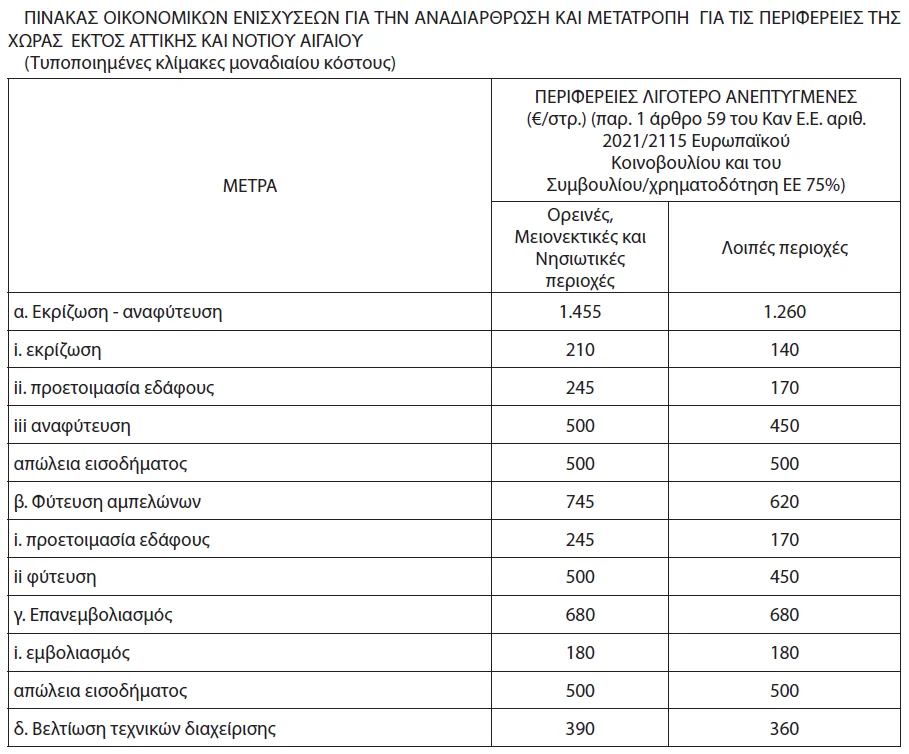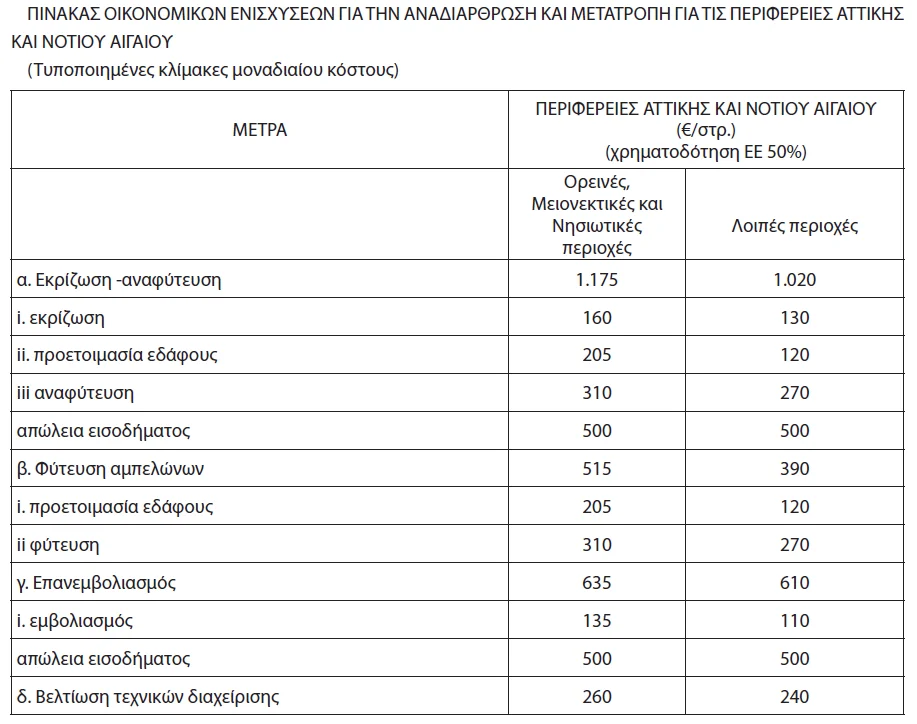
The period of application of the intervention for restructuring and conversion of wine-growing areas in Greece concerns the 2023-2024 wine year.
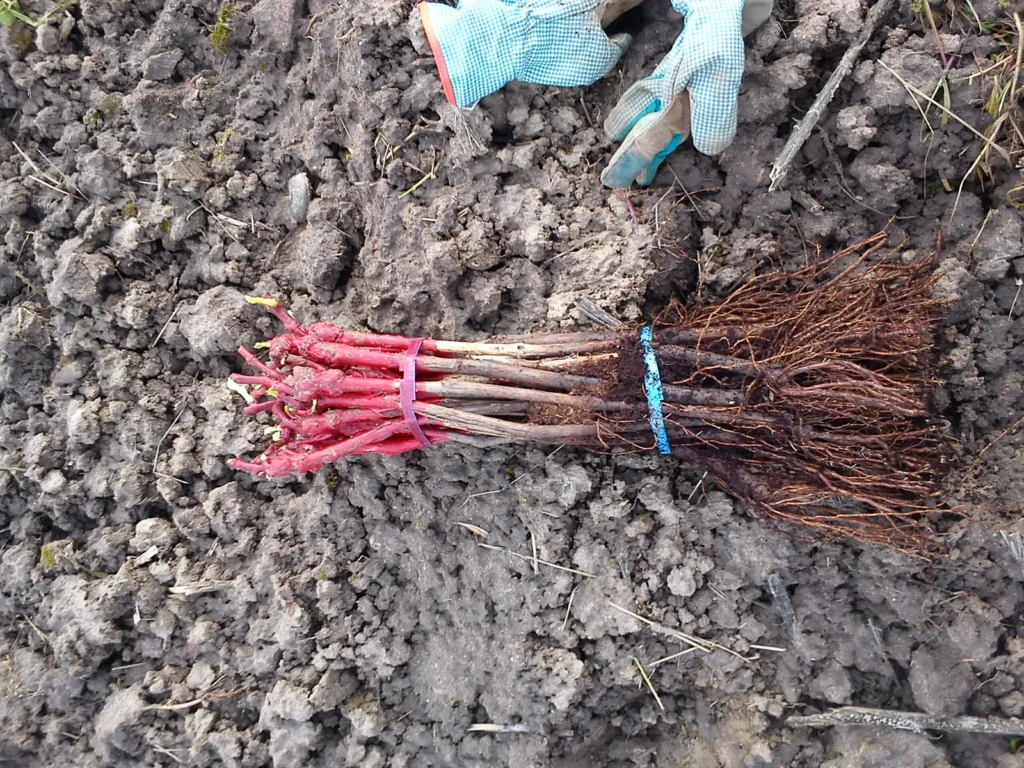
The intervention shall cover one or more of the following actions:
the varietal conversion of vineyards, including grafting-on;
(b) the relocation of vineyards;
improvements in vineyard management techniques linked to the objective of the intervention.
The actions are broken down into concrete measures that should make significant structural changes to the vineyard.
The above-mentioned actions include the following measures:
(a) grubbing-up-relaying, divided into:
- grubbing-up,
- soil preparation,
iii. replanting- relaying
(b) Planting of vineyards comprising:
- soil preparation,
- planting (based on a replanting authorisation in accordance with Article 66 of Regulation (EU) No 1308/2013),
c) Re-vaccination (for the varietal conversion of vineyards),
Improvement of certain techniques for managing wine-growing areas broken down into:
- construction of terraces
- hypostyllosis
* For each wine year, the allocation of funds to eligible applications shall be based on the following , criteria until the available budget is exhausted.
(a) New producers: Producers who are under 40 years of age and have parcels with wine grape varieties are considered to be new producers.
Areas intended for restructuring in the context of the viability of small and medium-sized holdings.
Areas facing natural or other specific constraints.
Areas where vineyards can produce superior quality:
Areas where vineyards contribute to the preservation of the environment
Inclusion for all measures
The vineyard restructuring and conversion intervention shall not cover the normal renewal of vineyards reaching the end of their natural life cycle. Normal renewal of vineyards approaching the end of their natural life means the replanting of the same parcel of land with the same variety according to the same system of viticulture.
Intervention shall apply only to areas which fulfil the following conditions:
(a) they are planted with wine grape varieties classified in accordance with Ministerial Decision 2919/95506/13-09-2017 ‘Classification of wine grape varieties and raisin varieties’ (Government Gazette, Series II, No 3276);
(b) they are registered in the Vineyard Register;
c) harvest declarations and/or production declarations have been submitted by producers for them and for their entire wine-growing holding, where required, for at least the two wine years preceding the period of inclusion in the Intervention.
Confirmation of the good existing cultivation status of the vineyard and its proper maintenance shall be carried out taking into account the findings of the on-the-spot pre-accession check in conjunction with the harvest declarations submitted;
d) a Single Aid Application has been submitted for them in the year of submission of the application,
the identification of the details of the wine-growing holding of the applicant producer for the intervention between the vineyard register and the single aid application is confirmed;
the obligations deriving from national and Union provisions have been complied with for the entire wine-growing holding;
g) the minimum area of a vineyard parcel for participation in the Intervention is set at half (0.5) acres of planted area, which means the area under Article 42 of Regulation (EU) 2022/126;
In the case of replanting of the same variety on the same parcel, a change in planting distances or a change in the number of vines with a minimum percentage change of 20 must be carried out.% the spacing or number of vines, before and after restructuring, unless there is another change in the management system;
areas planted with the varieties ‘Xinomavro’ and ‘Negoska’ in the Regional Unit of Kilkis, which participate in ‘PDO Goumenissa’ wine, may not participate in the intervention for the actions ‘grubbing-replanting with another variety’ and ‘re-vaccination’ for reasons of protection and preservation of the wine-growing profile of the Zone. Areas may participate in the ‘growing-replanting with the same variety’ and in the ‘replanting’ action where they result from grubbing-up of areas with only Xinomavro and/or Negoska varieties and where they are to be planted only with the same Xinomavro and/or Negoska varieties.
For the same reason, in the Regional Unit of Achaia, the ‘Corinthian’ and ‘Mavrodaphne’ varieties participating in the ‘Mavrodaphne of Patras’ PDO wine, as well as the ‘Moschato Aspro’ variety participating in the ‘Moschatos of Patras’ and ‘Moschatos of Rio Patras’ PDO wines, cannot participate in the Intervention for the same actions. On the other hand, the varieties Tsapourno in the Regional Units of Kilkis and Kotsifoliatiko in the Regional Units of Chania, Rethymno, Heraklion and Lasithi may participate only in the following actions:
- grubbing up/replanting with another variety
- (ii) revaccination;
i) vineyard parcels are included in the intervention, as recorded in the submitted application for inclusion by the producer (of a specific location and area) for the period of application of the intervention.
The establishment of the new vine plantation is carried out:
in the same place as the one grubbed up or in a different location on the same holding, on one or more parcels and on an area equivalent to that grubbed up;
(b) in accordance with modern vine-growing systems whether or not trellised,
(c) in accordance with the applicable national legislation (Ministerial Decision 2454/235853/20-9-2019 (Government Gazette, Series II, No 3645), as in force, laying down the additional measures necessary for the implementation of Regulations (EU) No 1308/2013, (EU) No , 2018/273 and (EU) 2018/274 on the management of wine-growing potential).
Beneficiaries of support for the restructuring and conversion of vineyards shall be exclusively wine growers holding vineyards or replanting or relaying authorisations, in accordance with Article 66 of Regulation (EU) No 1308/2013.
That is, they can be natural or legal persons, who cultivate wine grape varieties and the headquarters of their holding can be located in any EU country and/or have a replanting authorisation in accordance with Article 66 of Regulation (EU) No 1308/2013 for as long as it is valid. In any event, such authorisations may be used for support under the intervention only for as long as they are valid.
For inclusion in the intervention, the producers concerned or their legal representatives submit to the Ministry of Rural Development and Food, through the digital service, an Application for a Solemn Declaration together with the necessary supporting documents.
The eligibility of applications shall be examined on the basis of the following criteria.
* For each wine year, the allocation of funds to eligible applications shall be based on the following , criteria until the available budget is exhausted.
(a) New producers: Producers who are under 40 years of age and have parcels with wine grape varieties are considered to be new producers.
Areas intended for restructuring in the context of the viability of small and medium-sized holdings.
Areas facing natural or other specific constraints.
Areas where vineyards can produce superior quality:
Areas where vineyards contribute to the preservation of the environment
Inclusion for all measures
The classification of eligible applications is done at country level, applying the general formula
Pt=W1*Pt1+ W2*Pt2+...... +Wn*Ptn
where: Pt= total points assigned to a specific individual application
W1, W2., Wn= Criteria Gravity Factor
Pt1, Pt2, Ptn = compliance factor with the criteria
← Priority Criteria | Score
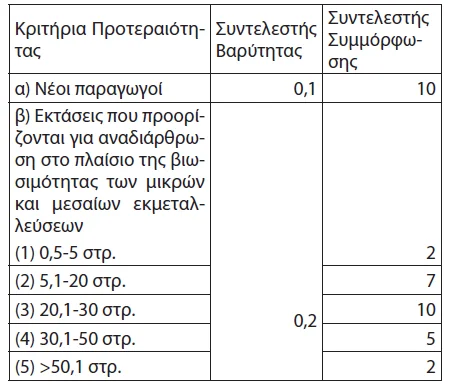
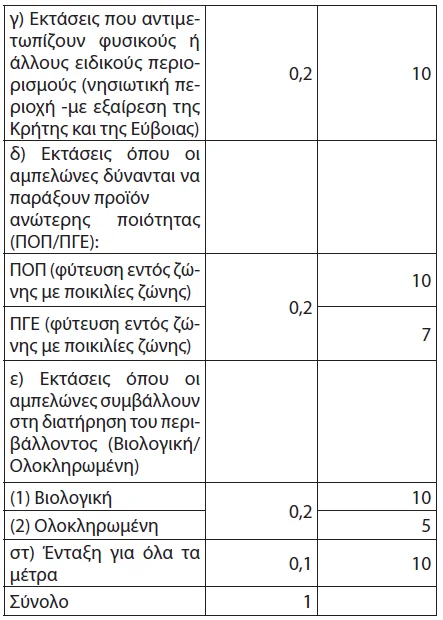
In the event that the available funds are exhausted for a ranking position in which several applications have been tied, the remaining funds shall be allocated to those applications on the basis of the application of the following additional priority criteria, which shall be aligned with the strategic objectives of the Intervention:
Priority shall be given to applications where the producer requests planting in the final position of the following indigenous varieties: White: Assyrtiko, Malagouzia, Vidiano Red: Agiorgitiko, Xinomavro, Mavrodaphne, Negoska Erythropes: Moschofilero
If even after the application of the above additional criterion there are still tied points, then
Priority shall be given to producers in ascending order of the size of a wine-growing holding (wine varieties), with a view to improving small and fragmented holdings.
The interested producers submit to the Ministry of Rural Development and Food, from 1 November 2023 to 20 November 2023, through the digital service of the Ministry of Rural Development and Food, an application for a solemn declaration and a detailed table of parcel data for inclusion in the intervention.
Source: Decision 3138/329916 (Government Gazette, Series II, No 6310, 6.11.2023) laying down the additional measures necessary for the implementation of intervention Π2 58.1 ‘Restructuring and conversion of vineyards’ in the wine sector in accordance with the 2023-2024 Common Agricultural Policy (CAP) Strategic Plan, pursuant to Article 58 of Regulation (EU) 2021/2115